
open-science
Open-source AI workbench for reproducible scientific research
Replaces Claude Science
Who it's for
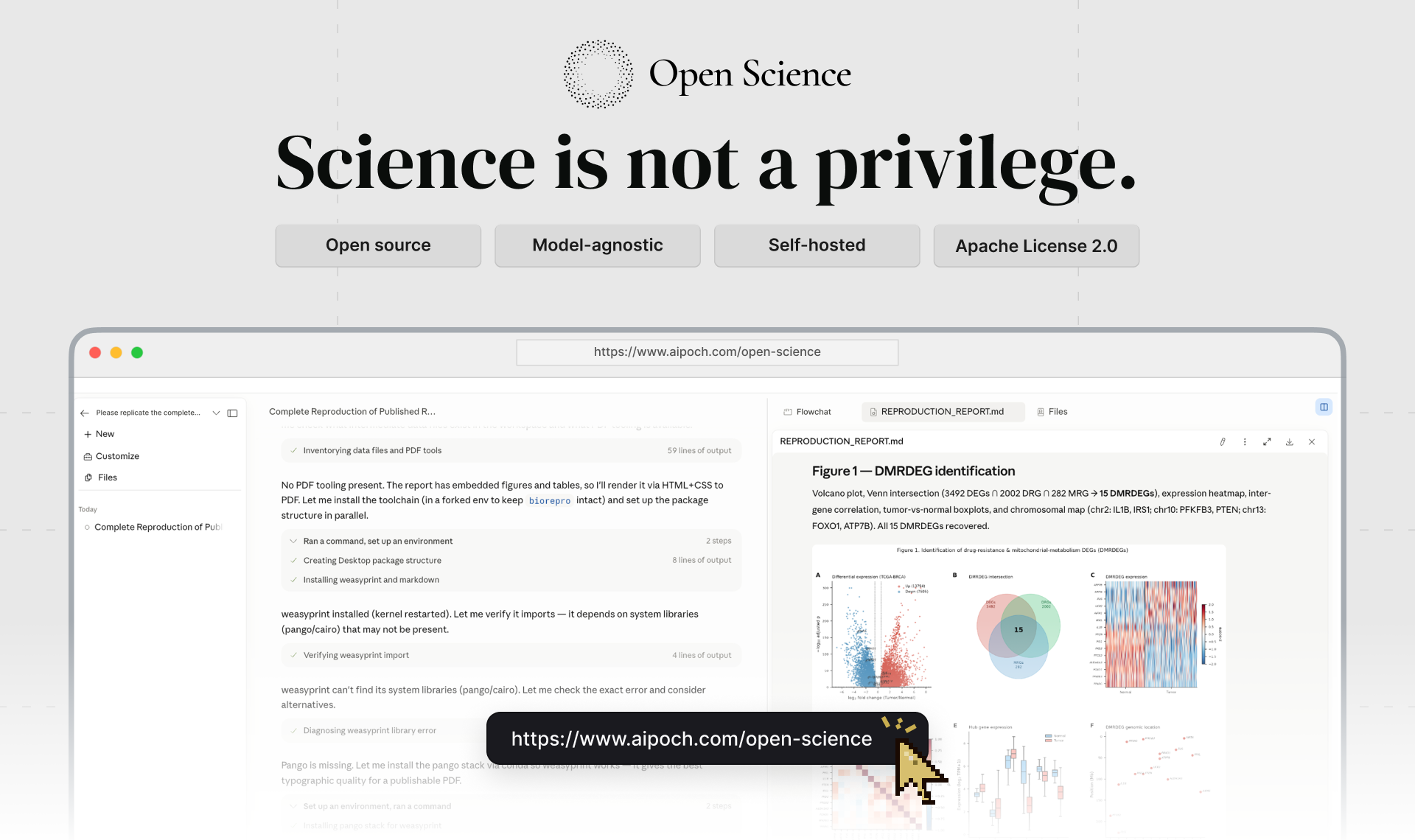
Open Science's persistent Python and R kernels, built-in bioinformatics connectors (PubMed, genomics databases, structural biology, protein annotation), and 22 scientific skills let a computational biologist run a full pipeline from literature search to data analysis to figure generation inside one workspace. Each artifact retains its provenance so the pipeline is reproducible and auditable.
Your work is purely statistical and already has a well-established Jupyter-based workflow. The desktop app adds overhead you may not need if you are not using agent delegation or the built-in connector features.
The local-first model means no institutional server or cloud subscription is required to get started. Researchers can run analyses on their own machine and submit long-running jobs to remote HPC clusters via SSH when local resources are insufficient, using the Slurm execution mode added in v0.26.0.
You need a shared, browser-accessible workbench that multiple collaborators use simultaneously from different machines. Open Science is designed for individual researchers working on their own hardware.
The provenance system, conversation branching, and versioned artifacts make it straightforward to track which model, data, and code path produced a given result. Researchers can explore alternative hypotheses by branching a conversation without losing the original session or blurring the record of earlier results.
Your experiments run entirely in Python scripts or notebooks and you have no need for agent-delegated tasks or scientific database connector integration. A standard notebook environment is simpler in that case.
The problem
Scientific research is scattered across tools that do not talk to each other: one chat interface for the AI conversation, a separate Jupyter notebook for code, a local file system for data, database query tools for literature and genomics, and presentation software for reports. At every handoff, context is lost. The agent's reasoning is stored in one window; the code that produced the result is in another; the files are somewhere else. The deeper problem is verifiability. When an AI agent produces a report or figure, it is rarely obvious which inputs it used, which code path it followed, or whether its claims are supported by the data it queried. Reproducibility collapses if you cannot trace a result back to its evidence.
How it works
Connect any cloud provider via API or an OpenAI-compatible gateway: OpenAI, Anthropic, xAI, and DeepSeek are built-in alongside dozens of additional providers. You select the model and reasoning effort per session, and switching providers does not change the workbench or project files.
Open Science provides persistent Python and R kernels alongside stateless shell execution. Variables and analytical state survive across related steps within a session, and a Variables view lets researchers inspect the live namespace between executions. Remote SSH compute handles jobs that exceed local resources.
Connectors cover scientific literature, PubMed, bioRxiv, genomics databases, BioMart, structural biology, protein annotation, ChEMBL, ZINC, clinical trials data, and more. Each connector runs through the workspace permission system, with per-tool Allow, Ask, or Block controls.
Every generated report, figure, table, or notebook is stored as a versioned, checksummed artifact. Its Provenance view records the producer code, execution history, environment details, the conversation branch, and reviewer findings. Missing evidence is shown as unavailable rather than guessed.
Purpose-built skills for AlphaFold2, Boltz, ESMFold2, Chai-1, LigandMPNN, literature review, computational biology, and remote HPC compute ship with the app. Researchers can also import personal or community-shared skills using the Skills system, or preview and install skills from GitHub.
Edit a completed user message to resend a revised prompt from that point. Open Science creates a new message branch instead of deleting the turns that followed, and revision controls let you switch between the original and alternative paths. Provenance stays tied to the exact branch that produced each artifact.
Features
- Model-agnostic provider support
- Persistent Python and R execution
- 24 built-in scientific data connectors
- Traceable research artifacts with provenance
- 22 featured scientific skills
- Conversation branching without lost work
Recommended for this setup
Strengths
- Apache-2.0 with no seat license: The app is free to download and run. You pay only for the model API or compute you choose to use. Unlike Claude Science and other commercial research platforms, there is no per-user charge or subscription required to run the workbench itself. The source code is inspectable and forkable.
- Local-first data ownership: Project files, sessions, notebooks, and generated artifacts are stored on your computer. External calls go only through services you explicitly configure. No research data is transmitted to AIPOCH infrastructure, which matters for institutions with data governance requirements.
- #1 on BiomniBench-DA Public 50: Open Science achieved the highest ranking score in the BiomniBench-DA Public 50 comparison, scoring 79.05 with gpt-5.6-sol at xhigh effort. The result averages a Gemini 3.1 Pro judge score of 81.04 and a DeepSeek v4-pro judge score of 77.06, placing it first among the collected Public 50 results.
- Cross-platform desktop with guided setup: Ships as a native desktop app for macOS (Apple Silicon and Intel), Windows, and Linux. No Docker, no database, no server configuration is needed for local use. The first-run wizard handles environment checks, model provider validation, and notebook runtime setup automatically.
Trade-offs
- Young project with 47 open issues: Open Science was created in July 2026 and had 47 open GitHub issues as of the research date. The tool is in active development, and some workflows or edge cases may be incomplete or subject to change between releases. Review the release notes before upgrading in a production research context.
- Inference cost is not included: The workbench is free, but every agent session calls an external model API at your cost. High-volume or long-running research tasks can generate significant API charges depending on the model and provider you choose. Budget planning around model usage is necessary for sustained research work.
- Desktop-only, no shared web interface: Open Science runs as an Electron desktop application on individual machines. Teams that need a shared, browser-accessible research environment where multiple collaborators work in the same session simultaneously will need a different approach, as there is no server mode or multi-user web UI.
Tech stack
FAQ
Yes. Open Science is Apache-2.0 licensed and free to download and run on your own machine. You pay only for the model API or external compute you connect to it. AIPOCH does not charge a seat license or subscription for the workbench itself.
Open Science is model-agnostic. Built-in providers include OpenAI, Anthropic, xAI, DeepSeek, Zhipu AI, Kimi, MiniMax, StepFun, NVIDIA, and others, plus any OpenAI-compatible custom gateway or self-hosted endpoint. The available model catalog follows your provider account and is selected per session.
Yes. Open Science is an Apache-2.0 alternative to Claude Science and similar proprietary AI research tools. Unlike Claude Science, it is not tied to a single model provider, runs locally on your machine without sending data to a third-party platform, and carries no per-seat charge. The project's own documentation notes it is not affiliated with or endorsed by Anthropic.
Open Science is local-first: project files, sessions, notebooks, and artifacts are stored on your computer. External calls go only through model providers and data connectors you explicitly configure. The app does not send research data to AIPOCH servers. This makes it suitable for institutions with data governance or confidentiality requirements.
Open Science includes 24 built-in connectors covering scientific literature, PubMed, bioRxiv, genes and ontologies, genomics databases, BioMart, genetic variants, structural biology, ChEMBL, ZINC, clinical trials, drug regulatory data, cancer model databases, and research resources. Connector access is controlled by per-tool permission settings (Always allow, Ask each time, or Block).