
Ntfy
Self-hosted push notifications via HTTP PUT, no sign-up required.
Replaces Pushover, Pushbullet
Who it's for
Trigger an HTTP POST at the end of a backup script, a database migration, or a cron job. Receive the notification on your phone immediately. No dedicated monitoring service needed for simple job-finished or job-failed alerts.
You need structured alerting with on-call routing, escalation policies, or integrations with PagerDuty and Grafana. ntfy is not a full incident management system.
Run the ntfy server on your own infrastructure and push notifications from Home Assistant, surveillance cameras, or IoT sensors without any traffic leaving your network. The Apache-2.0 license permits commercial and personal use with no restrictions.
You need a managed service with guaranteed uptime SLAs. Self-hosting ntfy requires maintaining your own server.
Any device that can make an HTTP request can send a notification: firmware-level curl, Python on a Raspberry Pi, or any embedded system with TCP/IP. No SDK, no registration, no cloud account required at the device level.
Your devices need two-way communication or command delivery. ntfy is a one-way notification channel; it does not support device management or command dispatch.
The problem
Getting notified when a background script finishes, a server goes down, or an automation hits a condition requires either a third-party paid service, a custom webhook setup, or a full messaging system. Pushover charges per-device fees. Pushbullet requires a registered account. Email notifications add latency and inbox noise. Building something custom means maintaining infrastructure just to send yourself a message. The harder constraint is the integration surface: most notification services require SDKs, app credentials, or API keys tied to a registered service account. For scripts, cron jobs, and IoT devices, the ideal is a single HTTP call with no prior registration and no dependency on the client side beyond curl.
How it works
Send a notification with a single curl command and no SDK or registration required. Any HTTP client works: `curl -d "Done" ntfy.sh/mytopic`. Topics are created on the fly when you first publish or subscribe, so setup is instant.
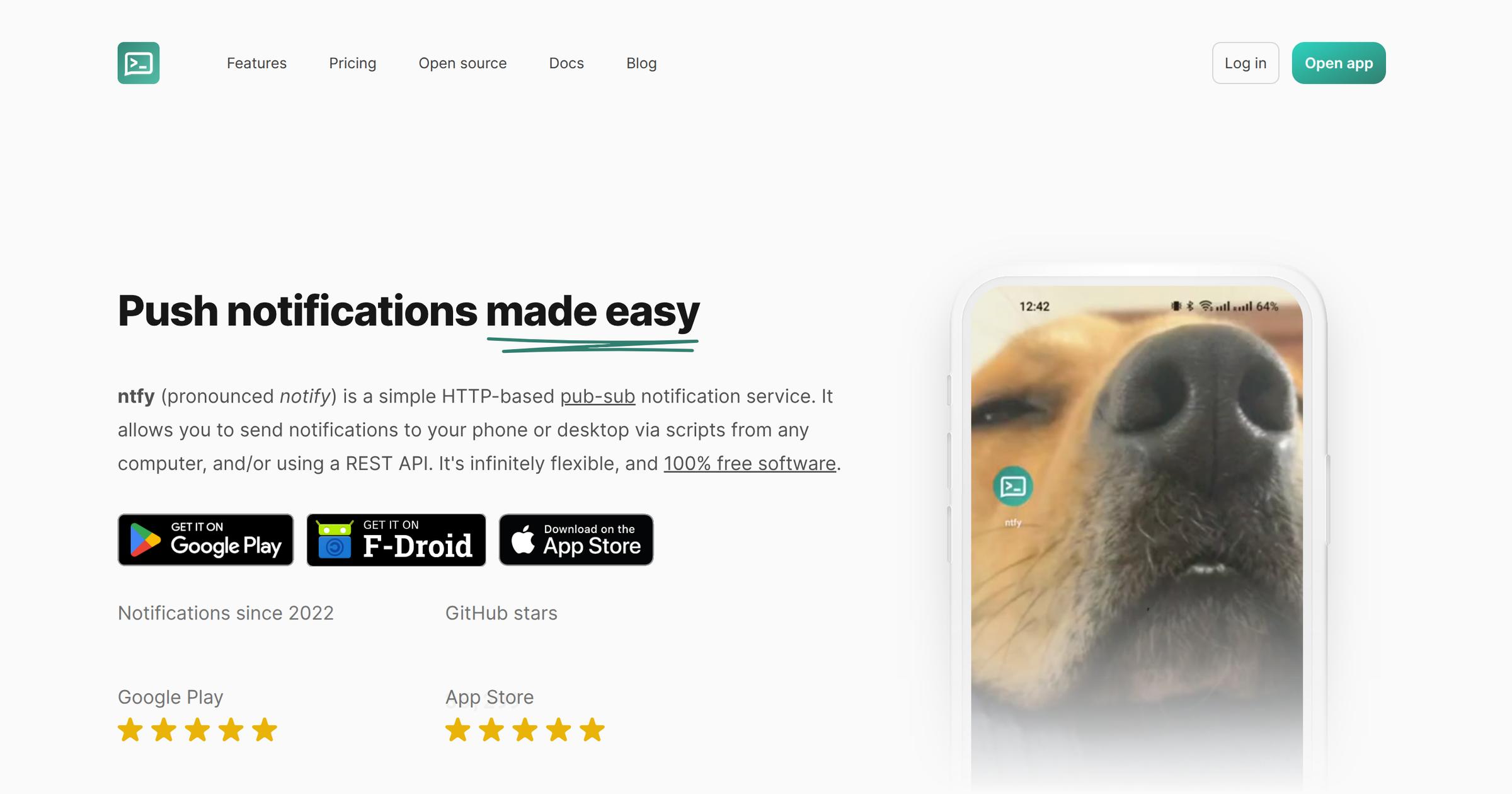
Android and iOS apps receive notifications in real time and are available on Google Play, F-Droid, and the App Store. The web app at ntfy.sh lets browsers subscribe to any topic and receive desktop notifications without installing anything.
Notifications carry a configurable priority (1-5) that maps to different sounds and vibration patterns. Action buttons let recipients respond directly from the notification. Attachments (images, videos, documents) can be sent alongside the message.
Publish to any topic string; anyone subscribed to that topic receives the message instantly. Topics function as a shared secret on the public server: an unguessable topic name keeps messages private without an account. Self-hosted deployments can add access control.
The ntfy server is a single Go binary with no external dependencies. It runs in Docker or bare metal, needs no database by default, and can be configured for access control, attachment limits, and SMTP email forwarding. Apache-2.0 licensed.
Features
- HTTP PUT/POST publishing from any client
- Mobile and desktop delivery
- Priorities, action buttons, and attachments
- Topic-based pub-sub routing
- Single Go binary, no dependencies
How to install
Self-hosting uses Docker with no external dependencies.
docker run -p 80:80 -itd binwiederhier/ntfy serveRecommended for this setup
Strengths
- Zero-registration access on the public server: ntfy.sh is free to use without creating an account. Pick a topic name, subscribe in the app, and start receiving notifications. No OAuth, no API key, no form to fill out. The only constraint is a daily rate limit on the public server.
- Single HTTP call from any language or tool: Any environment that can make an HTTP request can send a notification: curl, Python requests, Go's net/http, home automation tools, GitHub Actions, or IoT firmware. There is no library to install and no SDK dependency to manage.
- 35,299 stars and active maintenance: With 35,299 GitHub stars and a last push on November 4, 2026, ntfy has strong community adoption and ongoing maintenance. Android, iOS, and the server are all open source and accepting contributions.
Trade-offs
- Public server topics rely on unguessable names for privacy: On ntfy.sh, topic names are public and an unguessable topic string is the only privacy mechanism. The free tier limits daily message volume and attachment size. Sensitive notifications or high-volume automation require self-hosting or a paid plan.
- 319 open issues as of November 2026: The repo carries 319 open issues. While the project is actively maintained, some feature requests and edge-case bugs are backlogged. Teams with specific requirements should review open issues before committing.
Tech stack
FAQ
Yes, the public server at ntfy.sh is free to use without signing up. The Apache-2.0 license also lets you self-host the server at no cost. Paid plans (starting at $5/month) are available on ntfy.sh for reserved topic names, higher message limits, email forwarding, and phone call alerts. Self-hosting gives you the same features at the cost of running your own server.
Pushover charges a one-time per-platform fee and requires a registered account. Pushbullet requires account registration and limits features on its free tier. ntfy is Apache-2.0 licensed, self-hostable, and usable without any account on the public server. The tradeoff is that ntfy's privacy model on the public server relies on unguessable topic names rather than authenticated channels.
Yes. The ntfy server is a Go binary that runs in Docker or directly on Linux. It requires no external database by default, though attachment storage requires disk or S3 configuration. Full install docs are at ntfy.sh/docs/install/.
Yes. The Android app is available on Google Play and F-Droid. The iOS app is on the App Store. Both are open source. A web app at ntfy.sh/app allows browser-based subscriptions without installing anything.
Paid plans on ntfy.sh set explicit daily message limits: 2,500 for the Supporter plan ($5/month), 20,000 for Pro ($10/month), and 50,000 for Business ($20/month). Anonymous use on the public server is rate-limited below the paid tiers. Self-hosting removes all message limits; the only constraint is your server's capacity.