Jentic One
Self-hosted agent broker with per-agent permissions and audit log
Replaces Composio
Who it's for
Claude Code, Codex, Cursor, and Cline users who need their agent to call external APIs (Stripe, GitHub, Zendesk, Slack) can connect them through Jentic One to avoid pasting credentials into prompts or agent context.
Skip if your coding agent only needs read access to a single API you control directly. A simple HTTP wrapper is simpler than standing up a broker.
Teams that must pass a security review before an agent touches production credentials can use Jentic One to establish credential boundaries, demonstrate per-agent scoping, and produce an audit trail for the review.
Skip if your security review requires a commercially supported product with an SLA. Jentic One is in public beta.
Agents running inside a private network can connect to a Jentic One instance on the same network without routing credentials through any external service. The OpenAPI spec import path works with private internal APIs too.
Skip if your agents only call public APIs through a managed connector that already satisfies your compliance needs.
The problem
Giving an AI agent API access typically means giving it an API key. Once that key is in the agent's context, the agent can call any operation the key permits, and there is no clean way to constrain it, audit what it did, or revoke access to one operation without rotating the key for every caller. The problem compounds when agents run with multiple credentials across several APIs. Keys end up scattered in environment files and prompt templates, with no record of which agent used which key to do what. When something goes wrong or a key needs rotation, there is no log and no targeted revocation path.
How it works
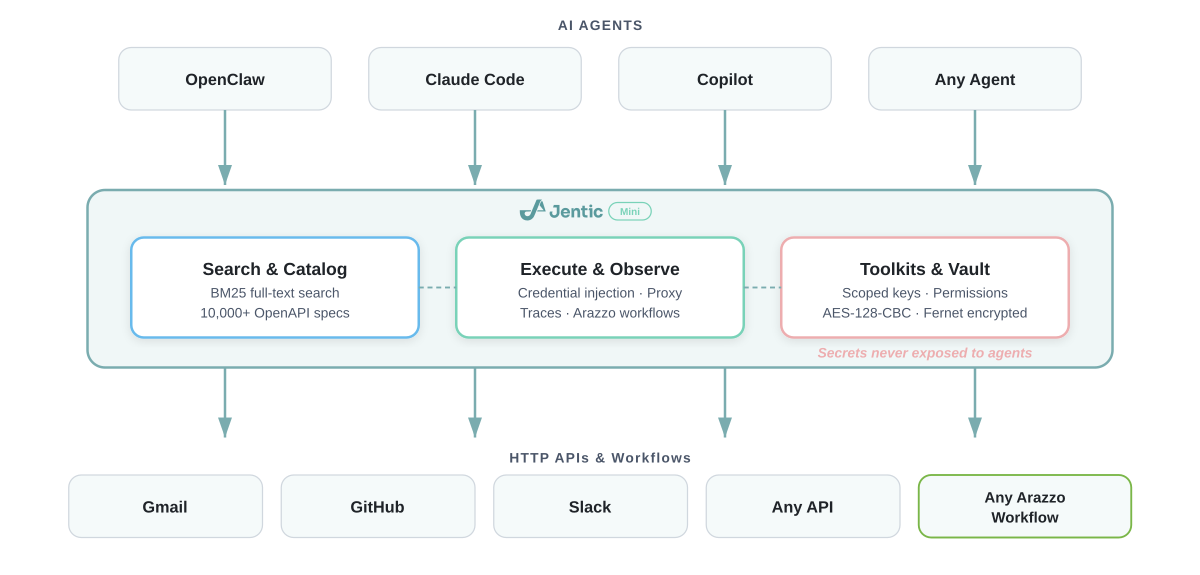
Stores API credentials encrypted on your infrastructure and injects them at call time. The agent never receives your keys; it calls the Broker, which attaches the credential and forwards the request. AES-256-GCM encryption at rest.
Bind each agent to the APIs and operations it needs and nothing else. Writes are never allowed by default; you explicitly grant them. Any call outside the granted scope is denied and recorded in the audit log.
Every call an agent makes, allowed or denied, is logged on your instance. The log is append-only and covers every request with the agent identity, operation, API, status, and latency.
Add any API by importing its OpenAPI spec. The Jentic API Directory offers thousands of validated specs to browse and import directly. Agents discover operations by intent, such as 'send a webhook' or 'create an invoice', and receive the matching operation with its input schema.
One Jentic One instance serves multiple agents, each with its own registered identity and permission scope. Agents connect as clients over HTTP or MCP from wherever they run, without needing access to the server's credential store.
Features
- Credential injection broker
- Per-agent permission scoping
- Append-only audit log
- OpenAPI spec import and API Directory
- Multi-agent support, one server
How to install
Quickstart (SQLite trial stack): back up the key in ~/.config/jentic-one/.env, run agents in a separate environment from the stack. The web app is at 127.0.0.1:8000.
curl -fsSLO https://raw.githubusercontent.com/jentic/jentic-one/main/deploy/docker/quickstart/docker-compose.yaml
mkdir -p ~/.config/jentic-one
(umask 077; set -C; echo "JENTIC_ENCRYPTION_KEY=$(openssl rand -base64 32)" > ~/.config/jentic-one/.env)
docker compose up -d --wait

# On the machine where the agent runs:
brew install --cask jentic/tap/jentic
jentic setup --url http://127.0.0.1:8000
Recommended for this setup
Strengths
- Full credential isolation, Apache-2.0: Credentials are stored once on your infrastructure and never passed to the agent. The agent can call any API you configure without ever holding a key. This core promise is backed by open source code you can read and audit under Apache-2.0.
- Default-deny with per-operation control: Every agent starts with zero API access; you grant exactly what it needs. Writes are blocked by default, and any call outside the grant is denied and logged. Revoking one agent's access to one operation does not affect other agents or require rotating any credential.
- Credentials never leave your infrastructure: Unlike managed agent-connector services, Jentic One runs on hardware you control. Credentials and the audit log stay on your instance; the Broker forwards only the allowed call to the upstream API. This matters for teams with security review requirements or data-residency constraints.
- MCP server and plain HTTP support: Agents connect to Jentic One through the jentic CLI, a generated skill, an MCP server, or plain HTTP. The jentic CLI and a generated skill are designed for coding agents like Claude Code, Codex, Cursor, and Cline.
Trade-offs
- Public beta: 0.x releases can break: Jentic One is in public beta. Schemas and CLI commands can change between 0.x releases; pin a specific version if you need stability. The README advises this explicitly.
- Same-OS-user agents can read CLI state: The Broker protects credentials from agents running as other OS users or on other machines. If the agent runs as the same OS user as its CLI state, it can read that state. The security docs recommend running Jentic One on a separate host or network from the agent.
- Telemetry on in the quickstart: The quickstart enables anonymous telemetry by default. The documentation includes an opt-out procedure; check it before deploying in a sensitive environment.
Tech stack
FAQ
The GitHub repository jentic/jentic-mini and the URL jentic.com/mini both redirect to Jentic One now. The repository history includes commits such as 'remove legacy jentic-mini content,' and the product was created in March 2026. The maker's current README does not describe a rename, so the continuity is inferred from the redirects and repository history, not from an announcement.
Yes. Jentic One is Apache-2.0 licensed and self-hosted. The source code is at github.com/jentic/jentic-one. It is in public beta, so pin a 0.x version if you need stability between releases.
No. Credentials are stored encrypted (AES-256-GCM) on your Jentic One instance. When an agent calls an API through the Broker, the Broker injects the credential at execution time and forwards the request. The agent receives only the API response, never the key.
Linux and macOS on x86-64 and ARM64, including Apple silicon. Windows is not directly supported: run the installer in WSL on a Windows machine. Docker is required for the quickstart install.
Jentic One is self-hosted: credentials and audit logs stay on your infrastructure. It is an open source credential-injecting agent broker with per-agent permissions, not a managed service or workflow engine. Composio is a managed platform that connects agents to over 850 apps, APIs, and workflows with managed authentication and developer tools; Jentic One is in public beta. The maker's own FAQ describes Jentic One as 'not a hosted service, not a workflow engine, and not an API gateway.'