
Jami
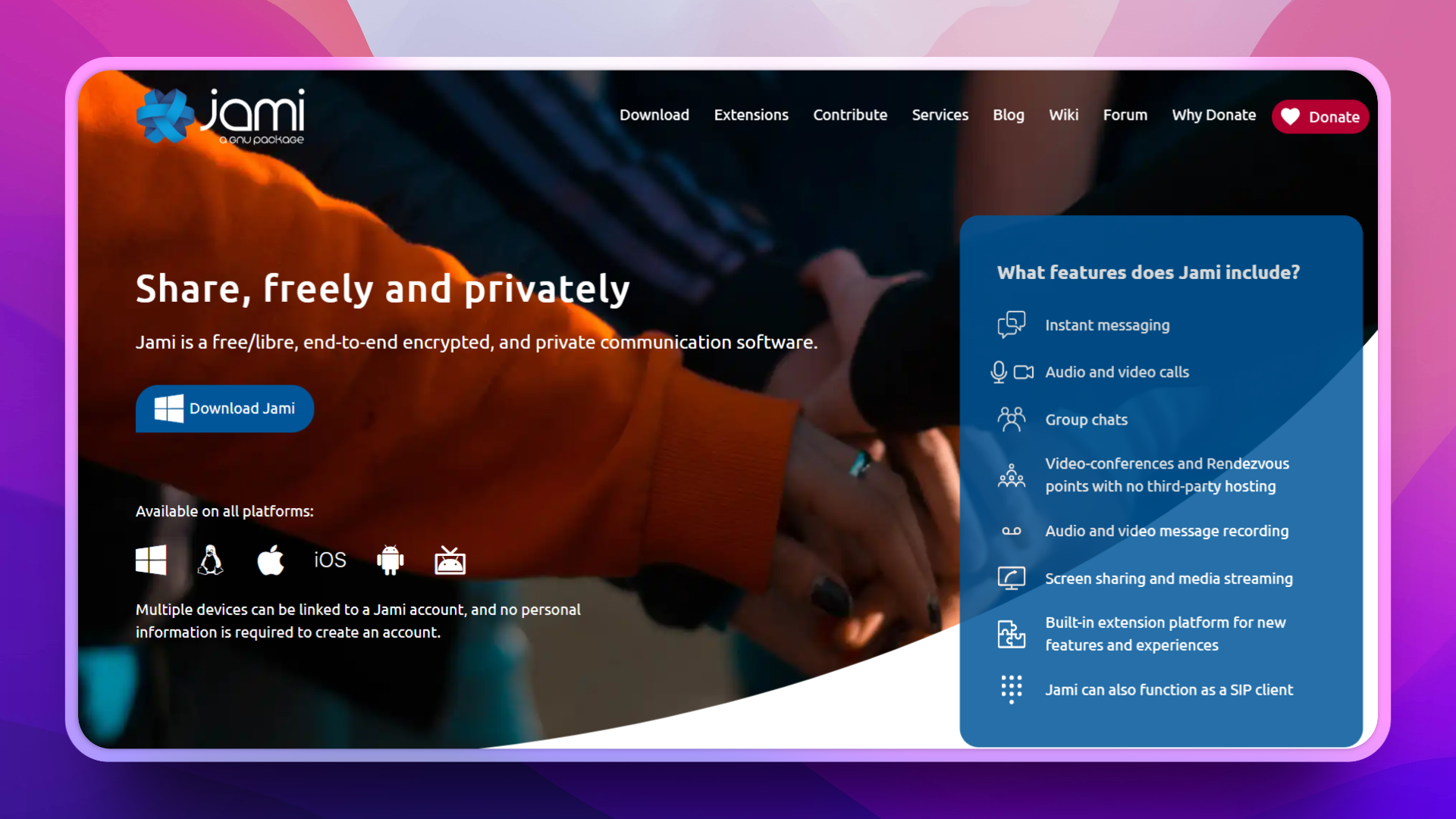
Free P2P encrypted messaging, calls, and file sharing
Replaces Whatsapp, Discord
Who it's for
Jami fits groups that want inspectable voice, video, messaging, and file transfer with less dependency on a central provider.
You need the simplest managed workspace chat with broad enterprise integrations.
The daemon repository helps developers work with the core communication logic separately from client interfaces.
You only need a hosted meeting app and do not plan to run or integrate communication infrastructure.
The problem
Centralized calling and messaging services put accounts, routing, and metadata under one provider. That can be convenient, but it creates privacy concerns, outage dependency, and limited control over communication infrastructure. Teams with stronger privacy requirements need communication tools that reduce central server reliance while still supporting practical calling, file transfer, and account workflows. They also need client and daemon boundaries developers can understand.
How it works
The README lists P2P-DHT support, which lets Jami route calls through a distributed model instead of depending only on a central service.
Jami can work with Asterisk through SIP accounts, which matters for organizations with existing VoIP infrastructure.
The README explains that the daemon handles business logic while user interfaces live separately, making integrations and alternate clients easier to reason about.
Features
- Peer-to-peer distributed calls
- SIP account compatibility
- Separate daemon and interfaces
Recommended for this setup
Strengths
- Distributed communication model: Jami is strongest for users who want chat and calling without putting every interaction through a centralized platform account.
- Useful VoIP bridge: SIP and Asterisk compatibility make Jami relevant for teams that already understand VoIP systems and need open client infrastructure.
Trade-offs
- Distributed systems can be harder to support: P2P communication can complicate troubleshooting, connectivity, and user onboarding compared with fully managed centralized services.
Tech stack
FAQ
Jami is used for voice, video, messaging, file transfer, and VoIP-style communication.
Yes. The README lists peer-to-peer distributed calls using P2P-DHT.
The README says the source tree contains the daemon that handles Jami business logic, while user interfaces live in separate repositories.