
inspo
Real production sites as design reference for AI coding agents
Replaces Refero, Mobbin
Who it's for
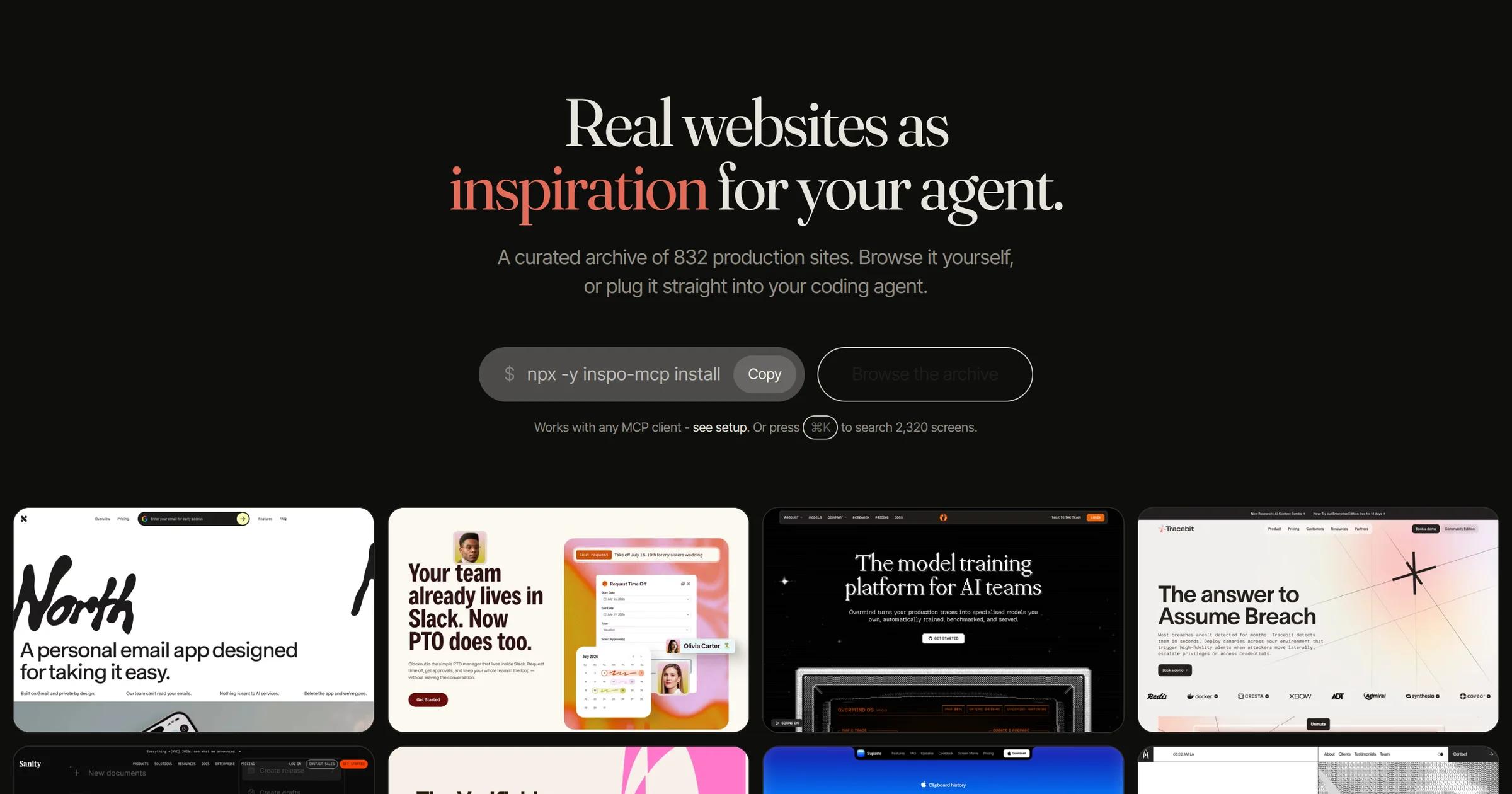
Add Inspo to Claude Code, Cursor, or Codex via one install command and the agent can pull real production references before drafting any component. The side-by-side in the README shows the gap between a bare agent's output and an Inspo-assisted one using the same brief and model.
If your project's UI is mostly internal tooling or the visual bar is low, the overhead of agent-queried references may not pay off. Generic dashboards rarely need brand-level design context.
The gallery browser at inspomcp.dev lets you search 2,320 screens from 832 sites without installing anything. Filter by component type, layout pattern, or visual style to study how real teams solve specific design problems.
If you need a mood board for client presentations, Refero's visual-browsing UI is optimized for that workflow in a way Inspo's MCP-first archive is not.
The hosted Streamable HTTP endpoint at inspomcp.dev/api/mcp works with any MCP-compatible client with no local setup. Point a client config file at the endpoint and the 15 tools are immediately available alongside existing agents and tools.
Teams with strict data privacy requirements should self-host. The hosted endpoint logs tool call metadata (tool name, success, duration) even though it does not log query text or IPs.
The problem
AI coding agents produce visually generic output by default. Without a reference layer, an agent given a UI brief falls back on its training data, which skews toward common patterns: dark themes, neon accents, floating card layouts. The result is recognizable as AI-generated and rarely matches what a designer would produce after studying real-world examples. The gap is not intelligence; it is exposure. A trained designer carries a mental library built from years of studying production sites. Agents have no equivalent. They cannot scan design archives or extract a site's CSS variables before writing a component. Inspo closes that gap by packaging 832 real production sites in a form agents can query: captured screenshots, traced palettes and type ramps, canonical JSX components, and per-site DESIGN.md files, all addressable from a single MCP server.
How it works
Every site is captured on desktop and mobile with traced palettes, real fonts, detected tech stack, and a fold-by-fold structural analysis. The archive covers 2,320 pages across 832 real production sites and is queryable by vibe, layout pattern, or component type via MCP tools.
Heroes, pricing sections, footers, navs, and more, each demonstrating one named macrostructure with copy-pasteable JSX. An agent can pull a specific component pattern by name and use the JSX directly in generated code without translating from a screenshot.
Every site in the archive has a DESIGN.md extracted from its DOM: semantic palette roles, type ramp, spacing scale, CSS variables, and container width. Agents can read a site's actual design system before writing styles, not just look at a screenshot and infer.
The `find_similar` tool and `recommend(brief)` use Together AI embeddings for semantic search across the archive. Ask for a minimal SaaS pricing page or an editorial blog with serif type and the server returns relevant captures ranked by similarity.
`npx -y inspo-mcp install` detects the active MCP client (Claude Code, Cursor, Codex, VS Code, Windsurf, Zed, or Claude Desktop) and writes the config automatically. A `--dry-run` flag shows the planned changes without applying them.
Features
- 832-site production archive with 2,320 captured pages
- 68 canonical reference components with JSX
- Machine-readable DESIGN.md per site
- Semantic search via Together AI embeddings
- One-command MCP install across seven clients
How to install
Run one install command and Inspo detects your MCP client and writes the config automatically.
npx inspo-mcp installRecommended for this setup
Strengths
- MIT license with no accounts or paywalls: The full archive is freely accessible with no accounts, usage limits, or subscription. The README states accounts and paywalls are skipped on purpose because the archive is more useful free. The MIT license also lets teams run a private self-hosted instance with no licensing fees, unlike paid design-reference services.
- Structured design data, not just screenshots: Most design-inspiration tools deliver a screenshot and stop. Inspo extracts the actual design system from each site's DOM: palette variables, type ramp, spacing scale, and CSS custom properties. An agent gets a DESIGN.md it can apply directly, not just an image it can describe.
- No database at query time: The catalogue ships as a static seed, so the MCP server stays fast and lightweight. There is no database to provision or manage when self-hosting, and no cold-start latency per query.
- Read-only security posture with SSRF guard: Every MCP tool is read-only. The one path that touches an external URL passes through an SSRF guard: public named hosts only, ports 80 and 443, byte-capped body, no JavaScript execution. The hosted endpoint logs only tool name, success, and duration, not IPs or query text.
Trade-offs
- Archive is a snapshot, not continuously updated: The 832 sites were captured at a point in time. Sites that redesign after capture will show outdated screens until the archive is refreshed. The open roadmap also notes that mobile shots still need a retina-scale re-shoot, and component crops for `find_components` are not yet complete for every entry.
- Self-hosting requires building from a TypeScript monorepo: Running the full stack locally means cloning the repo, running pnpm install, and starting the Next.js gallery and MCP server separately. There is no Docker image or single-command self-host documented in the README; the hosted endpoint at inspomcp.dev/api/mcp is the easier path for most teams.
Tech stack
FAQ
Yes. The hosted endpoint and the full archive are free with no accounts or usage limits. The project is MIT licensed, so self-hosting is also free. The README notes that accounts and paywalls are skipped on purpose because the archive is more useful free.
The `npx -y inspo-mcp install` command auto-detects and configures Claude Code, Cursor, Codex, VS Code, Windsurf, Zed, and Claude Desktop. Any other MCP-compatible client can connect directly to the hosted Streamable HTTP endpoint at inspomcp.dev/api/mcp without any install script.
Yes. Clone the repo from GitHub, run pnpm install, and start the gallery and MCP server locally. The self-host runbook is in DEPLOY.md in the repository. For most teams the hosted endpoint is the easier starting point; self-hosting makes sense when you need local control or have data privacy requirements.
Every captured screen credits and links its source site. Screenshots remain the work of their original designers; Inspo does not claim that copyright. Takedown requests are honored at inspomcp.dev/dmca.
Refero is a paid design-inspiration tool aimed at human designers browsing screenshots. Inspo is MIT-licensed and built for the agent workflow: its archive is queryable via MCP tools, and each site ships a machine-readable DESIGN.md rather than just a screenshot. The primary consumer of Inspo's archive is an AI coding agent querying an API, not a human browsing a gallery.