
hysteria
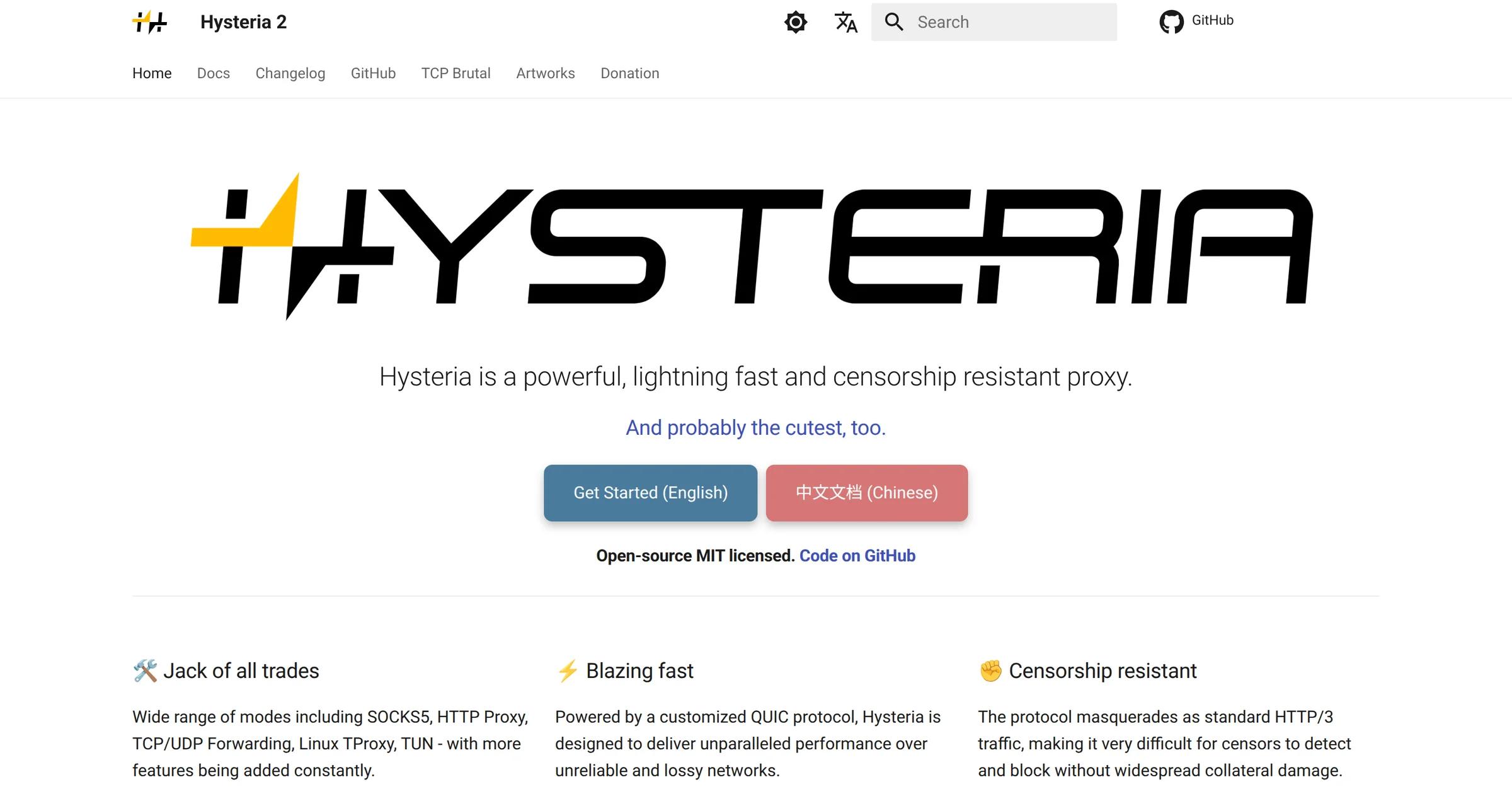
Fast and censorship-resistant proxy solution
Replaces Astrill Vpn, Nordvpn, Mullvad Vpn
Who it's for
Routes development traffic through a personal Hysteria server on a VPS to access blocked resources behind a heavily filtered corporate or national network.
Maintains secure communications that are not detectable as proxy traffic in a country with active deep-packet inspection.
Adds Hysteria as a backup tunnel for team members who need reliable access from restricted network locations.
Uses Hysteria's protocol documentation to implement a compatible client and test censorship circumvention techniques.
Deploys Hysteria with custom authentication to give employees private proxy access with per-user traffic statistics.
The problem
Standard proxies using TCP-based protocols are easily fingerprinted and blocked by deep packet inspection systems. Networks with high packet loss make TCP-based tunneling slow and unreliable, especially on mobile or satellite connections. Users in restricted environments need a proxy that performs well under both censorship and poor connectivity, without relying on protocols that are trivial for ISPs to identify and drop.
How it works
Masquerades as standard HTTP/3 (QUIC) traffic, making it indistinguishable from normal web browsing to deep packet inspection systems
Supports SOCKS5, HTTP proxy, TCP/UDP forwarding, Linux TProxy, and TUN modes from a single binary
Built on a customized QUIC implementation tuned for unreliable and lossy networks where TCP suffers head-of-line blocking
Cross-platform builds for every major OS and CPU architecture
Built-in custom authentication, traffic statistics, and access control for server operators managing multi-user deployments
Well-documented protocol spec enables third parties to build compatible client applications
Features
- HTTP/3 masquerade against DPI
- SOCKS5, HTTP, TProxy, and TUN in one binary
- QUIC-based, tuned for lossy networks
- Cross-platform binaries
- Built-in auth and per-user traffic stats
- Open protocol spec for third-party clients
Recommended for this setup
Strengths
- HTTP/3 masquerade has high collateral cost to block: HTTP/3 masquerade is harder to block selectively than most proxy protocols because blocking it causes widespread collateral damage to legitimate QUIC/HTTP3 traffic
- Single binary for all proxy modes: A single binary covers a wide range of proxy modes without requiring separate tools for different use cases
- 21.2K stars, active community: 21.2K GitHub stars with active maintenance and an active Telegram community and Discussions forum
- Open specs for third-party clients: Well-documented specifications lower the barrier for third-party client authors
Trade-offs
- Requires self-hosted server in unrestricted location: Requires running your own server in an unrestricted location; there is no built-in server-discovery or relay network like some commercial VPN services offer
- Higher CPU/battery than TCP proxies on stable networks: The QUIC-based approach consumes more CPU and battery than simple TCP proxies in stable, low-latency network conditions
- Some edge-case rough spots: 236 open issues at last check; some edge-case platform configurations may have rough spots
Tech stack
FAQ
Hysteria uses UDP/QUIC and mimics HTTP/3 traffic at the protocol level. Shadowsocks and V2Ray primarily operate over TCP and are more easily identified by traffic-analysis tools. On high-latency or lossy networks, Hysteria's QUIC base typically outperforms TCP-based proxies significantly.
Yes. Hysteria does not include a public relay network. You need a server in an unrestricted location running the Hysteria server binary. The documentation at v2.hysteria.network covers setup for common VPS providers.
Hysteria has an active third-party app ecosystem with iOS and Android clients available, though the core project ships only a command-line binary. Check the third-party apps section in the official documentation for current options.