
freellmapi
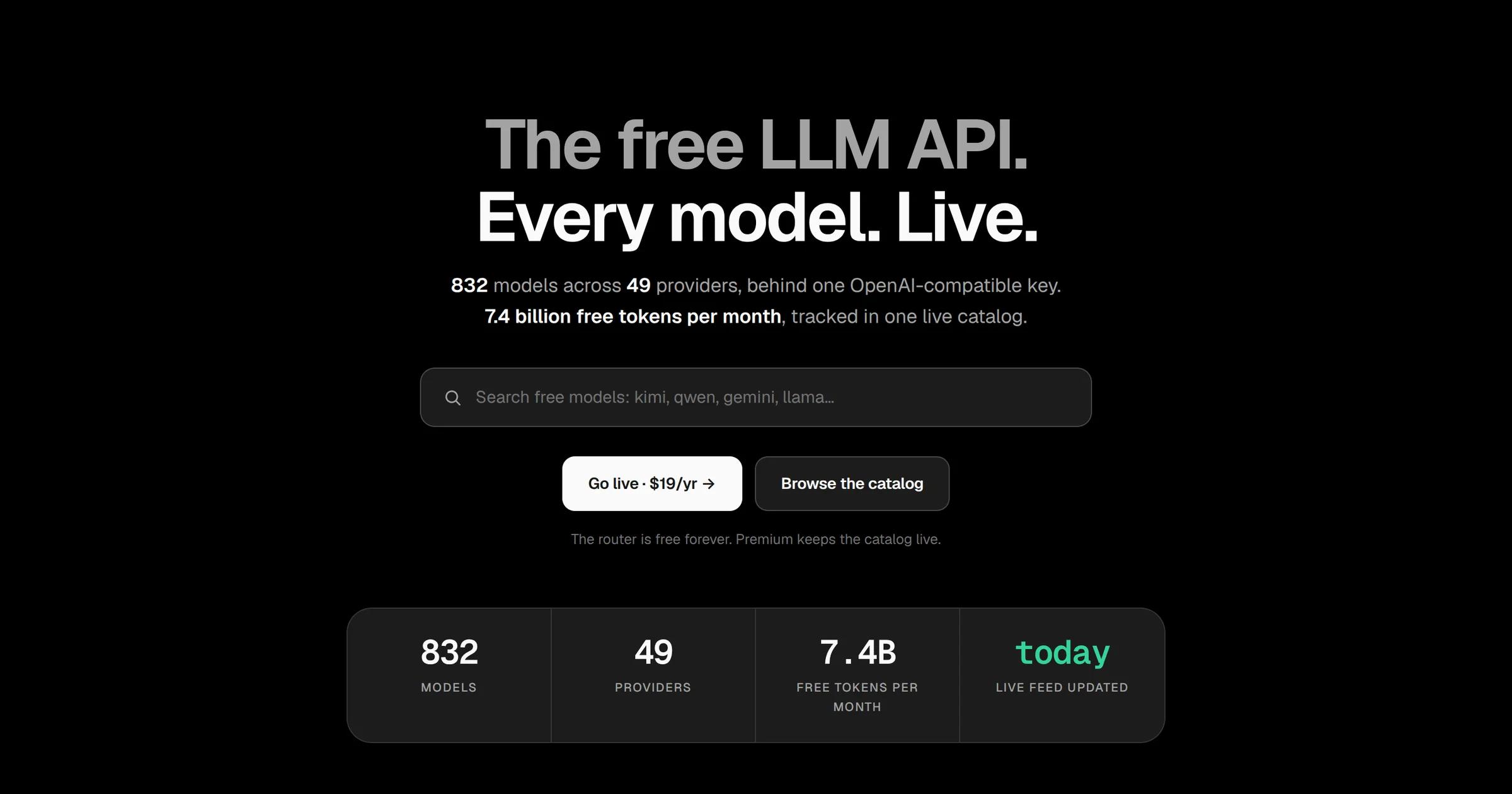
One OpenAI-compatible key for 635 free LLM endpoints
Replaces Openrouter, Vercel Ai Gateway, Portkey, Braintrust Gateway, Dmxapi
Who it's for
FreeLLMAPI gives Claude Code, Codex CLI, Cline, Aider, and 12 other agents a free model pool to draw from. Setup generators configure the agent in one command, pointing it at localhost:3001 with the unified key. No credit card, no usage bill.
Skip if you need production SLA guarantees or multi-user isolation. The tool is designed for single-user personal use, and the repository explicitly scopes it to personal experimentation.
The live catalog covers 474 model families across 34 providers. The admin dashboard playground lets you test prompts against any model in the pool. Per-key usage counters surface which provider is closest to its rate cap in real time.
Skip if your evaluation needs are commercial or team-wide. FreeLLMAPI aggregates free tiers only; paid-tier models are not in scope unless you add a custom OpenAI-compatible endpoint.
7.4 billion tokens per month across 635 endpoints is a meaningful inference budget for solo development. The router handles failover silently, so your app keeps working when one provider hits its rate limit. MIT license means you can ship a product built on it without licensing friction.
Skip if your application will serve multiple end users making concurrent requests. FreeLLMAPI is a single-user local router, not a multi-tenant API gateway.
The problem
Every major AI lab now offers a free inference tier: a few million tokens per month, a few thousand requests per day. The challenge is that stacking thirty-four of these tiers by hand is painful. Each provider has its own SDK, its own rate-limit policy, and its own failure mode. A single application needs thirty-four API keys, thirty-four error handlers, and thirty-four places a request can silently drop. Beyond the integration cost, the free-tier landscape changes constantly. Providers launch models, retire them, and change quotas without notice. Keeping a hand-rolled aggregator in sync requires ongoing maintenance on top of the original engineering work. Most developers either limit themselves to one or two providers, accepting unnecessary cost ceilings, or take on the burden of a brittle multi-provider setup.
How it works
A single /v1 endpoint accepts any OpenAI-compatible client: SDKs, coding agents, or direct HTTP. The router exposes chat completions, embeddings, image generation, audio, and the Responses API that Codex CLI requires. Anthropic SDK clients can use /v1/messages directly, and Gemini CLI speaks its native /v1beta wire.
Live per-model speed, capability, and reliability scores rank the fallback chain for each request. On a 429 or 5xx, the router retries the next available model automatically, with cooldowns and key rotation to stay under every free-tier cap. Six configurable routing strategies let you bias toward speed, capability, or cost.
The router pulls a signed catalog from freellmapi.co twice daily. New models, quota changes, and provider-quirk fixes land without a git pull or container restart. Free installs receive the monthly snapshot (30-day delay per model); premium routers get updates the same day.
Provider API keys are AES-256-GCM encrypted in SQLite and decrypted in-memory per request. Your applications see only a single unified freellmapi bearer token. Bulk import, export, and scheduled health checks are available from the admin dashboard.
Request the virtual fusion model and the router fans your prompt out to a panel of diverse free models in parallel, then a judge model synthesizes one answer from the drafts. Useful for tasks where consensus across multiple models improves output quality without additional cost.
A native menu-bar app runs the full router locally on macOS and Windows. Setup generators like npx freellmapi setup-claude and setup-codex configure Claude Code, Codex CLI, Cline, Aider, and 12 other agents automatically, backing up your existing config before merging.
Features
- OpenAI-compatible API across 635 free endpoints
- Smart routing with six strategies and automatic failover
- Self-updating signed model catalog
- AES-256-GCM encrypted key storage
- Fusion multi-model synthesis
- Desktop app and coding agent setup generators
How to install
Self-hosting uses Docker and takes one setup command to install.
curl -fsSL https://freellmapi.co/install.sh | bashRecommended for this setup
Strengths
- MIT licensed with zero routing overhead: The core router is MIT licensed and costs nothing to run. Unlike commercial gateways such as OpenRouter or Portkey, which charge subscription fees or per-token markups, FreeLLMAPI routes across your own provider keys with no middle-layer fee. The only cost is the compute for a roughly 40 MB RSS process.
- 7.4 billion free tokens per month across 34 providers: By aggregating free tiers from 34 providers across 635 endpoints, FreeLLMAPI turns individually toy-sized quotas into a working inference budget. Google, Groq, Cerebras, Mistral, Cloudflare, and 29 more providers contribute to the pool, stacking what would otherwise be isolated limits.
- Works with every OpenAI-compatible client and several native formats: Any tool that can target a base URL works: set it to http://localhost:3001/v1 with the unified key. The router also speaks the Anthropic Messages API wire format, the Gemini /v1beta format, and NDJSON for Ollama-compatible clients. No client-side code changes required for most integrations.
- Strong community growth since April 2026: 21,620 GitHub stars and 3,061 forks since the repository was created in April 2026. CI is active, PRs are welcome, and the project ships a Chinese-language README alongside the English one, indicating active international adoption.
Trade-offs
- Scoped to personal experimentation by design: The repository description explicitly states 'Personal experimentation only.' Teams running production workloads or multi-user applications should evaluate whether this scope boundary fits their requirements before depending on the router in a shared environment.
- Free installs receive model catalog updates with a 30-day delay: Free installs receive the monthly model catalog snapshot, meaning a new model or quota change reaches them 30 days after it joins the live feed. Staying current requires a premium subscription at $19 per year or a $49 one-time lifetime purchase.
- No managed hosting: you own the reliability: There is no hosted option for the router itself. If your server goes down, routing stops. Commercial gateways like OpenRouter and Portkey operate with redundancy and SLA guarantees; FreeLLMAPI delegates reliability entirely to your own infrastructure and operations.
Tech stack
FAQ
The core router is free and MIT licensed. You run it on your own hardware with your own provider API keys, which are also free. A premium subscription at $19 per year (or $49 one-time lifetime) unlocks same-day model catalog updates; free installs receive the monthly snapshot with a 30-day delay per model.
FreeLLMAPI aggregates free tiers from 34 providers including Google, Groq, Cerebras, Mistral, Cloudflare, Cohere, NVIDIA, HuggingFace, and OpenRouter. The full list with per-model rate limits, context windows, and token budgets is at freellmapi.co/models. You can also add any OpenAI-compatible custom endpoint.
Yes. FreeLLMAPI includes automated setup generators for Claude Code, Codex CLI, Cline, Roo Code, Continue, Aider, Goose, and Cursor, among others. The npx freellmapi setup-claude command configures Claude Code to use the local router in one step, backing up your existing config before merging.
Yes. The router exposes a full OpenAI-compatible /v1 endpoint: chat completions, embeddings, image generation, audio, and the Responses API. It also speaks the Anthropic Messages API wire format for Claude Code and the Anthropic SDK, and the Gemini /v1beta format for Gemini CLI.
The fastest path is a one-liner: curl -fsSL https://freellmapi.co/install.sh | bash. It sets up a directory, generates an AES-256-GCM encryption key, pulls the Docker image, and starts the container on port 3001. Windows users can download the .exe installer from the GitHub Releases page; macOS has a native menu-bar app.