
comma.ai
Open source AI driver assistance for supported vehicles
Replaces Tesla Full Self Driving, Mobileye, Gm Super Cruise
Who it's for
improve long-distance lane assist and cruise comfort on a compatible car instead of replacing the vehicle
your car is not in the supported list.
run experiments on logging, control behavior, and feature changes with inspectable code
you need a certified OEM-grade production toolchain only.
use openpilot as a practical ADAS baseline for teaching sensor fusion and control logic
curriculum requires official vendor certification.
standardize assist behavior across repeated vehicle variants with one software stack
your fleet spans many unsupported makes.
The problem
Drivers rely on factory driver-assistance features that can be inconsistent across vehicles, expensive to upgrade, and hard to inspect or customize. openpilot gives an open source ADAS path for compatible cars with stronger transparency for software behavior, logs, and deployment control. It is for technically minded drivers, researchers, and teams that want a configurable roadmap, not a closed vendor lock-in model.
How it works
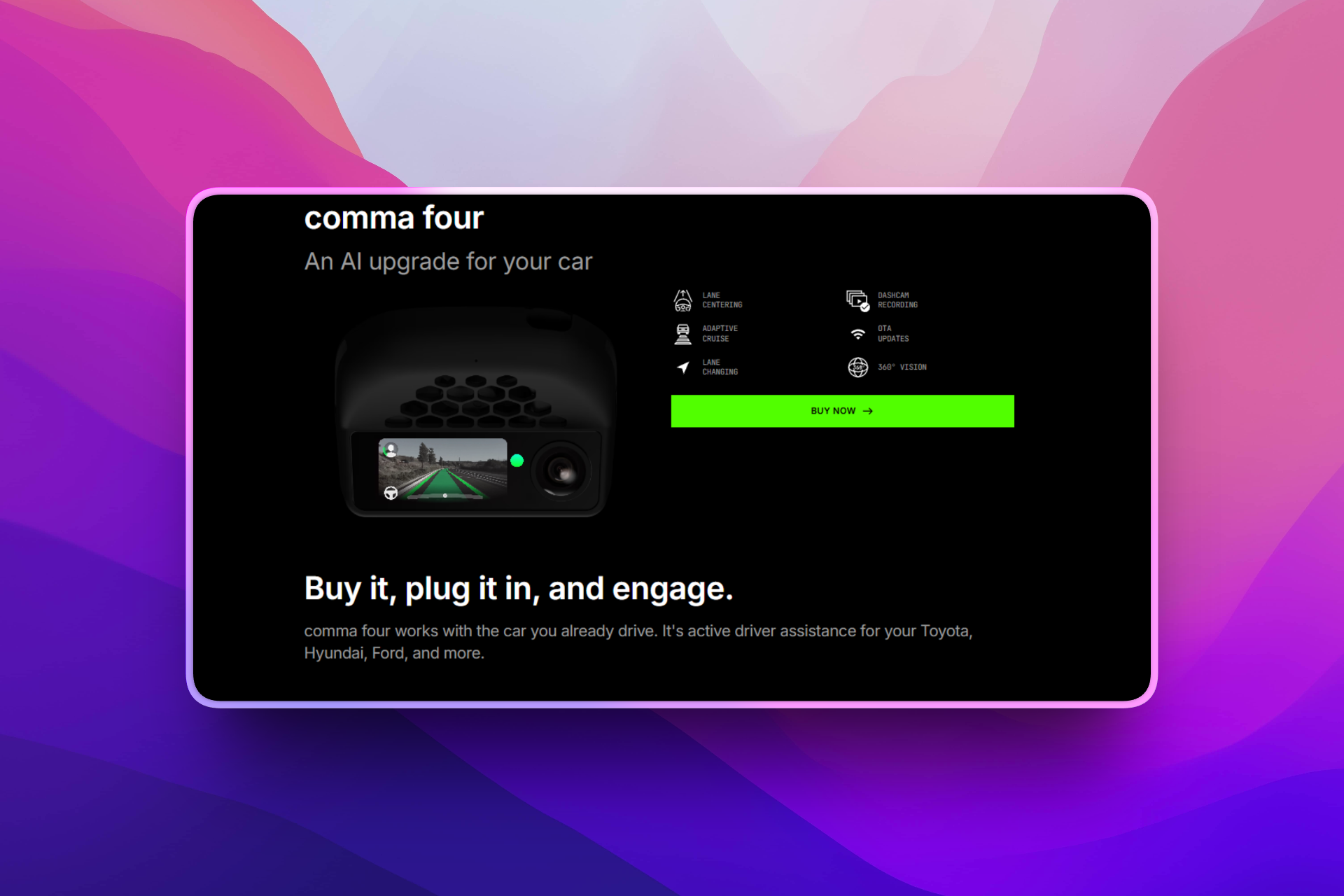
upgrades lane centering, adaptive cruise control, forward collision warning, and lane departure warning on supported vehicles through the openpilot stack.
uses comma hardware with setup flow documentation for supported vehicle installs.
supports 300+ cars with an active compatible car list maintained in the project docs.
follows ISO 26262 references, SIL safety process, and continuous software-in-the-loop and hardware-in-the-loop validation in the openpilot workflow.
source is licensed as MIT, enabling code reuse, audits, and local customization under standard MIT terms.
Features
- Open-source ADAS stack for supported cars
- Device-based rollout on comma four
- Broad model support target
- Safety-first engineering practices
- MIT license
How to install
bash <(curl -fsSL openpilot.comma.ai)Recommended for this setup
Strengths
- Full code visibility: teams can inspect logic and behavior instead of treating ADAS logic as a hidden service.
- Cost control for experimenters: avoids the same closed subscription lock pattern seen in premium assist stacks and lets teams stage rollout on their own schedule.
- Developer-friendly path: release and branch model supports experimentation and local testing while keeping a stable release branch for non-advanced users.
Trade-offs
- Harness and compatibility dependency: deployment depends on supported car models, comma hardware, and a correct harness path for each vehicle.
- Not a full autonomy solution: lane centering and cruise support are assistance features, not full self-driving in all conditions.
- Research orientation and risk posture: openpilot is alpha-quality software for research use, so teams need stronger process control before broad consumer rollout.
- Data behavior defaults: data upload defaults may be enabled, so teams should review settings and privacy expectations before deployment.
Tech stack
FAQ
It replaces or upgrades stock L2 assist experiences on supported non-Tesla vehicles with a custom, open alternative that runs on comma hardware.
Yes. You need one of the supported comma devices and a compatible car plus harness setup, otherwise openpilot cannot run properly.
No. It is driver assistance software with limitations and conditions, and the driver remains responsible for safe operation.
The software stack is open source, so no software subscription is required to run openpilot itself on supported hardware, though hardware and optional services may cost extra.
You can disable features like driver-facing camera logging in settings, but you should review data and account settings before use.