
Claude-BugHunter
83 skills for bug hunting, red-team work, and reporting in Claude Code
Replaces —
Who it's for
The 58 hunt-* skills and 681 pattern corpus map directly to the vulnerability classes H1 and Bugcrowd pay on. VRT-aware severity output, OOS rebuttal blocks, and evidence-hygiene checks (cookies, PII redaction) address the submission-side gaps that hurt validity ratios on platforms with strict duplicate and severity thresholds.
You hunt primarily on platforms with custom severity models outside HackerOne or Bugcrowd VRT, such as crypto-focused bug bounty programs where the core risk framing differs significantly from web-app vulnerability classes.
The enterprise platform matrices (M365/Entra, Okta, vCenter, SSL-VPN appliances, SharePoint) carry current 2024-2026 CVE chains and post-credential escalation paths for AWS keys, JWTs, and GCP JSON credentials. The red-team report template produces 50 KB+ DOCX-compatible deliverables, not bug-bounty report stubs.
Your engagement scope includes internal Active Directory, lateral movement, or C2 tradecraft. The bundle deliberately excludes those phases; Impacket, NetExec, BloodHound, and Rubeus are outside its scope by design.
The multi-agent install (--all flag) copies skills to Claude Code, OpenCode, Codex CLI, Hermes Agent, and Google AntiGravity simultaneously. Battle-tested on public training platforms including DVWA, OWASP Juice Shop, Hacker101, and testphp.vulnweb.com, so the skill behavior is validated before a first real target.
You need binary exploitation, kernel pwn, browser internals, or hardware security skills. These are out of scope for this bundle.
The 58 web-app vulnerability-class skills and the recon layer work on repos you own. Frame the engagement as a defensive review ('check this against the OWASP Top 10', 'secure refactor to remediate'), which fits the authorized-use model and reduces classifier friction on Anthropic's models without requiring CVP enrollment.
You need SAST or SCA tooling integrated into a CI/CD pipeline. This bundle operates interactively inside Claude Code, not as an automated scanner stage in a build system.
The problem
Generic AI assistants fail mid-engagement in security work. They produce plausible-sounding test cases without knowing which payloads bypass real-world filters, and they carry no context for how triagers on HackerOne or Bugcrowd actually evaluate reports. The pain compounds fast: a hypothesis drafted before validation means wasted hours and a hurt validity ratio; the wrong VRT severity mapping auto-downgrades a P3 finding to P4; screenshots get submitted with cookies and victim PII still visible. External red-team engagements expose a second layer of gaps: no current CVE chains for enterprise targets (M365, Okta, vCenter, SSL-VPN appliances), no model for post-credential escalation when recon yields AWS keys or JWTs, and no client-facing report format that meets an enterprise deliverable standard. These are the specific gaps documented across real authorized engagements before the first line of this bundle was written.
How it works
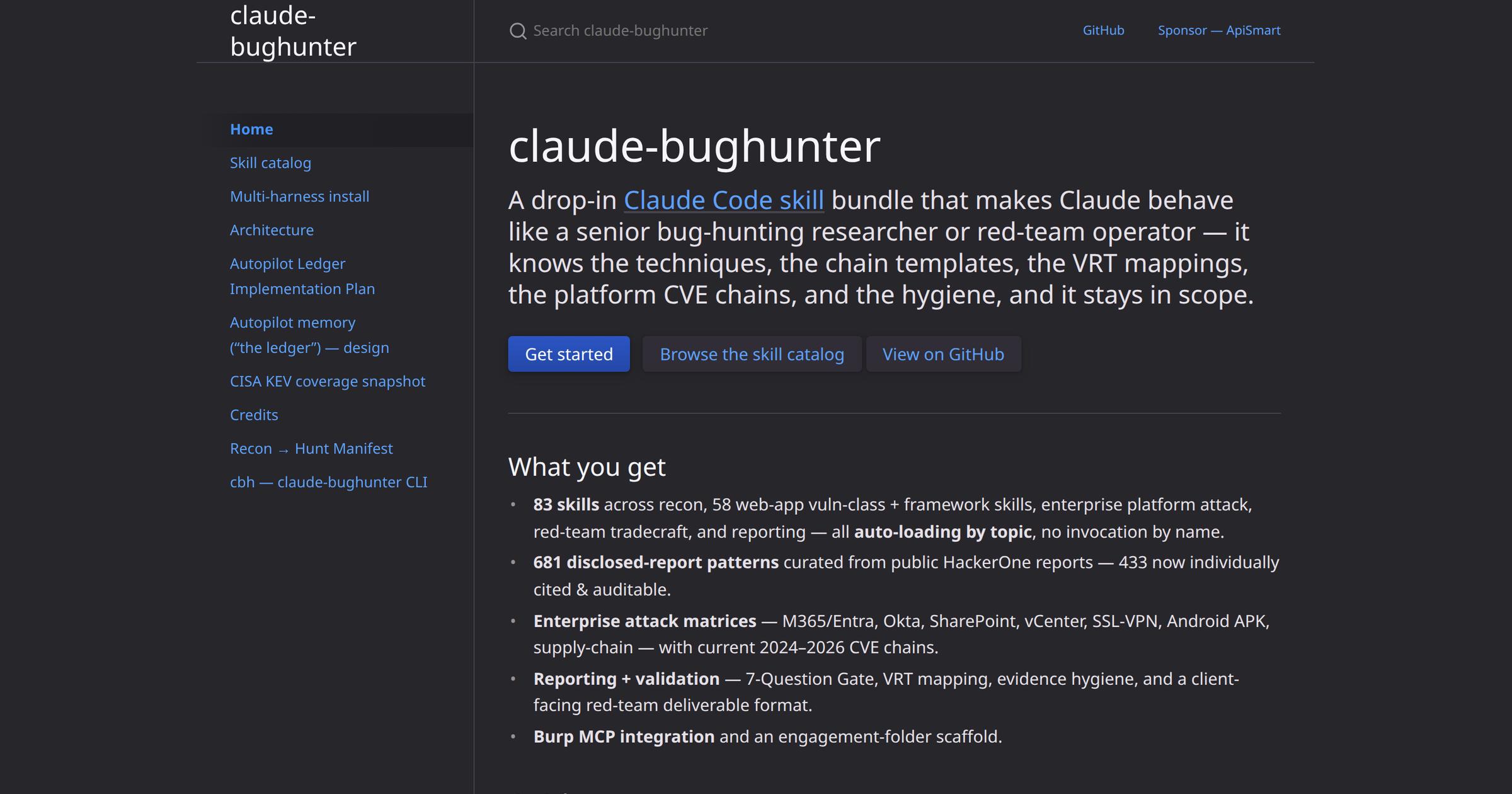
Covers recon and OSINT (5 skills), 58 web app vulnerability classes, enterprise platform attacks (M365/Entra, Okta, vCenter, SSL-VPN appliances), red-team tradecraft, and reporting. Describe what you are testing in plain English and the relevant skill loads without naming it; no manual invocation required.
Curated from public HackerOne reports, 433 of them now individually cited and auditable. Each hunt-* skill includes per-class detection patterns, payload tables, bypass techniques, and chain templates sourced from real triager-validated findings, not abstract OWASP descriptions.
Covers M365 and Entra ID, Okta as an IdP, SharePoint on-prem (ToolShell and legacy SOAP), VMware vCenter and Workspace ONE, SSL-VPN appliances (Cisco, Fortinet, Citrix, Palo Alto, Pulse, SonicWall, F5), Android APK red-team, and cloud IAM post-credential escalation. Each matrix carries current 2024-2026 CVE chains.
The triage-validation skill fires before any submission: it checks whether the asset is in scope (Q3) and on the program's accepted-impact list (Q2). Report output maps severity using VRT defaults for HackerOne and Bugcrowd, with an OOS rebuttal block and evidence-hygiene checks (cookies, PII redaction) built in.
Skills are plain SKILL.md files readable by Claude Code, OpenCode, OpenAI Codex CLI, Hermes Agent, and Google AntiGravity. The install script's --all flag detects installed agents and copies skills to each; --burp-mcp wires the Burp MCP server into every one. The cbh CLI installs standalone via pipx.
Features
- 83 skills auto-loaded by topic
- 681 disclosed-report patterns across 24 vulnerability classes
- Enterprise platform attack matrices with current CVE chains
- 7-Question Gate and VRT-aware reporting
- Multi-agent compatibility
How to install
Install the bundle by cloning the repository and running the setup script for your platform.
git clone https://github.com/elementalsouls/Claude-BugHunter.git
cd Claude-BugHunter
bash scripts/install.sh
Recommended for this setup
Strengths
- MIT license with no server or subscription required: The entire bundle is MIT licensed; install it, fork it, modify it, or ship it into an internal toolkit without restriction. It runs inside Claude Code on the researcher's own machine, so there is no hosted service to pay for, no per-engagement fee, and no data leaving your control.
- Patterns from 433 individually cited HackerOne reports: The 681-pattern corpus is not synthesized from documentation: it is curated from public disclosed reports, with 433 now linked to their source. Each pattern carries the actual chain template a real triager paid for, not an OWASP checklist summary. That specificity is what separates evidence-backed hypothesis generation from guesswork.
- Scope enforcement built into every skill: The triage-validation skill's 7-Question Gate fires on ambiguous targets; the bundle documents its own exclusions explicitly (no C2, no internal AD, no post-exploit) rather than leaving them implied. The /hunt scaffold states the engagement frame on its first turn, reducing classifier refusals on authorized offensive work.
- Active project with 6,467 stars and 3 open issues: With 6,467 GitHub stars, 972 forks, and the last push on 2026-11-15, the project is actively maintained. Only 3 open issues at time of writing. The v3 community expansion added 20+ framework and surface skills beyond the original 24 vulnerability classes.
Trade-offs
- Authorized offensive work requires Anthropic's Cyber Verification Program: Anthropic's models apply real-time safeguards that block exploitation tooling by default, and the bundle cannot override them. Authorized pentesters and bug hunters need to enroll in Anthropic's free Cyber Verification Program (CVP) before the full skill set works as intended on live offensive tasks. On Opus 5, some higher-risk requests fall back to Opus 4.8 mid-session, which can be easy to miss in a long agentic run.
- External attack surface only; internal AD and post-exploit excluded: Internal Active Directory attacks (BloodHound, Kerberoasting, DCSync, Pass-the-Hash, AD CS abuse), C2 frameworks (Cobalt Strike, Sliver), post-exploit persistence, AMSI bypass, iOS pentesting, binary exploitation, and kernel pwn are all explicitly out of scope by design. Teams running internal red-team engagements that include domain-takeover chains need separate tooling for those phases.
- Plugin install path lacks the hunt scaffolder and cbh CLI: The plugin route (the fastest install) loads all 83 skills and 15 slash commands namespaced under claude-bughunter:, but the engagement-folder scaffolder (/hunt engine) and cbh CLI are only available with the full clone install. Plugin users can add cbh standalone via pipx, but the hunt scaffolder requires the clone.
Tech stack
FAQ
It installs and runs without CVP, but Anthropic's real-time safeguards block exploitation tooling by default, so authorized offensive work (live bug bounty, pentest, red team) will hit refusals on certain tasks. CVP is free and application-based; it adjusts the safeguards for legitimate dual-use work. Mass data exfiltration and ransomware development stay prohibited and cannot be adjusted via CVP.
The plugin route (/plugin marketplace add elementalsouls/Claude-BugHunter inside Claude Code) loads all 83 skills and 15 slash commands namespaced under claude-bughunter: and updates when you bump the plugin version; no files are copied to ~/.claude/. The copy install (bash scripts/install.sh on macOS/Linux) copies skills and commands into ~/.claude/ and also installs the hunt engagement scaffolder and the cbh CLI. Plugin users can add cbh standalone via pipx install git+https://github.com/elementalsouls/Claude-BugHunter without a full clone.
The reporting skills target HackerOne, Bugcrowd (VRT-aware), Intigriti, and Immunefi, plus a client-facing red-team deliverable format for enterprise engagements. The 7-Question Gate in triage-validation checks scope and program impact before any submission to guard against invalid or duplicate reports.
M365 and Entra ID, Okta as an IdP, SharePoint on-prem (ToolShell plus legacy SOAP), VMware vCenter and Workspace ONE, SSL-VPN appliances (Cisco, Fortinet, Citrix, Palo Alto, Pulse, SonicWall, F5), Android APK red-team, and cloud IAM post-credential escalation (AWS STS AssumeRole, IMDS chains, cross-account confused-deputy, GCP JSON keys). Each matrix carries current 2024-2026 CVE chains.
No. Internal AD attacks (BloodHound, Kerberoasting, DCSync, Pass-the-Hash, AD CS abuse, ntlmrelayx) are explicitly out of scope by design. The bundle covers the external attack surface only; handoff to internal red-team tooling (Impacket, NetExec, Rubeus, BloodHound) is intentionally outside its scope. The README notes that coverage for internal AD and post-exploit may come in a future update.