
Cerbos
Move access control out of app code into testable YAML policies
Replaces Plainid, Axiomatics, Permit Io
Who it's for
Use Cerbos when tenants, roles, and resource-level rules change often and need clear policy ownership.
Your app only has one or two static roles and no compliance pressure.
Use Cerbos to provide a shared authorization layer across services without forcing every team to invent permission checks.
Each service has unrelated authorization rules and no shared policy governance.
Use Cerbos when access decisions need version history, tests, and explainable policy files.
A managed identity platform already covers your authorization needs with acceptable audit output.
The problem
Authorization logic gets dangerous when every service implements permissions differently. Route handlers, database filters, and business logic accumulate scattered checks that are hard to audit and harder to change. Enterprise customers then ask for new roles, attributes, or compliance evidence, and each policy change becomes an application release risk.
How it works
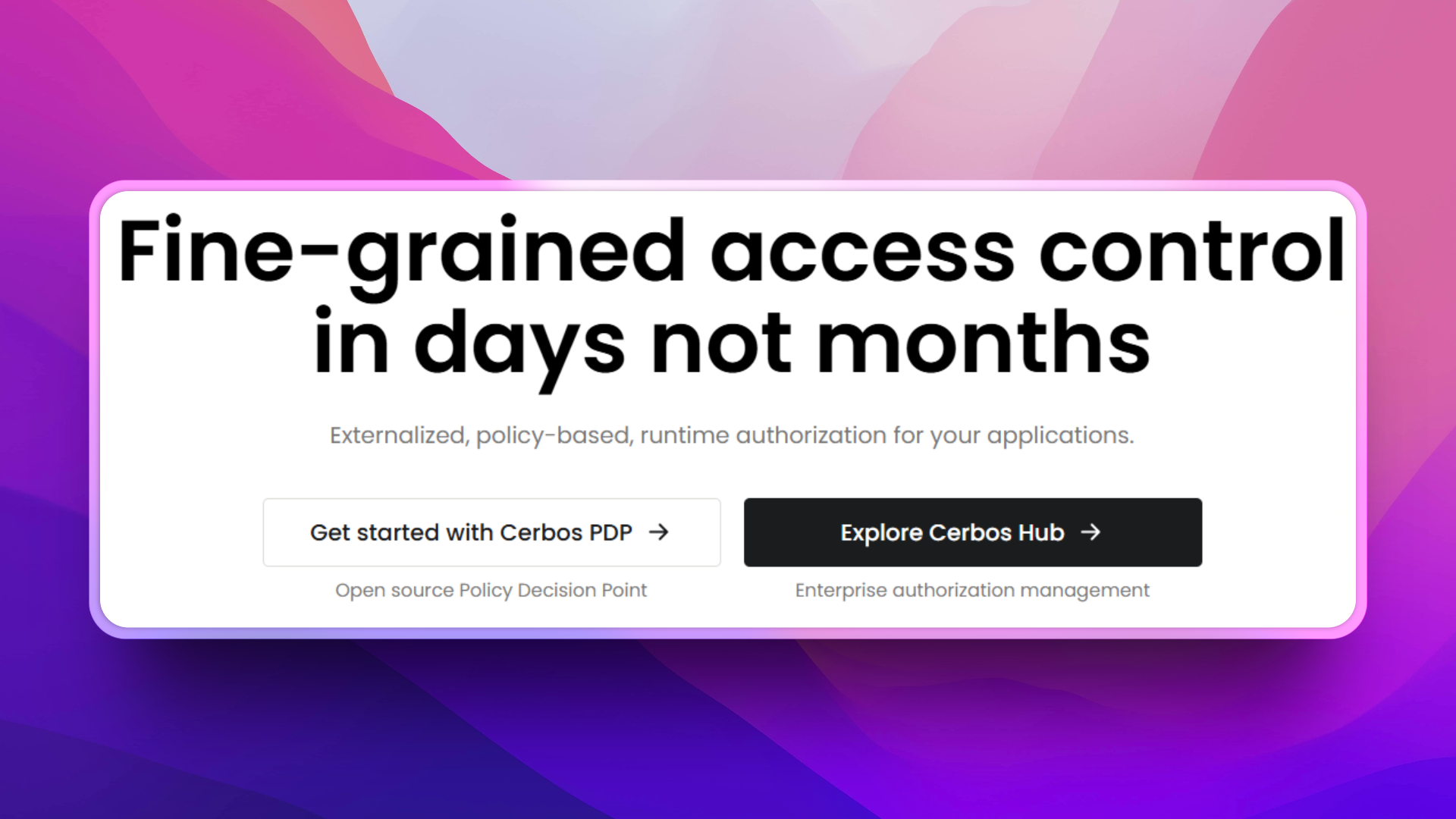
Cerbos runs as a PDP that receives principal, resource, and action data, then returns allow or deny decisions through APIs.
Access rules live in structured YAML policies that can be stored on disk, in Git, cloud object stores, or supported databases.
Cerbos supports role-based rules and attribute-based conditions, allowing teams to model simple roles and more granular contextual access checks.
Kubernetes service, sidecar, systemd service, and AWS Lambda deployment paths let teams place the PDP near the applications it protects.
Features
- Policy decision point service
- YAML policy-as-code
- RBAC and ABAC support
- Deployment flexibility
Recommended for this setup
Strengths
- Centralizes authorization decisions: Cerbos gives applications one policy decision interface instead of scattering permission logic throughout codebases.
- Works with existing identity providers: Cerbos handles authorization, not authentication, so it can sit behind Auth0, Cognito, Okta, custom JWTs, or internal identity systems.
- Good GitOps fit: Policy files can move through Git review and automated tests, which makes access control changes easier to audit.
Trade-offs
- Adds an authorization service to operate: Teams must deploy, monitor, and version the PDP and policy store. Inline checks may be faster for small products with simple permissions.
- Requires policy modeling discipline: Cerbos helps centralize policy, but teams still need to model resources, actions, roles, and attributes carefully to avoid confusing rules.
Tech stack
FAQ
Cerbos evaluates authorization policies outside application code and returns access decisions for principals, resources, and actions.
No. Cerbos handles authorization and can work with identity providers that supply user or service principal data.
Yes. Cerbos supports self-hosted PDP deployment through Kubernetes, sidecar, systemd, and serverless options.