
Azimutt
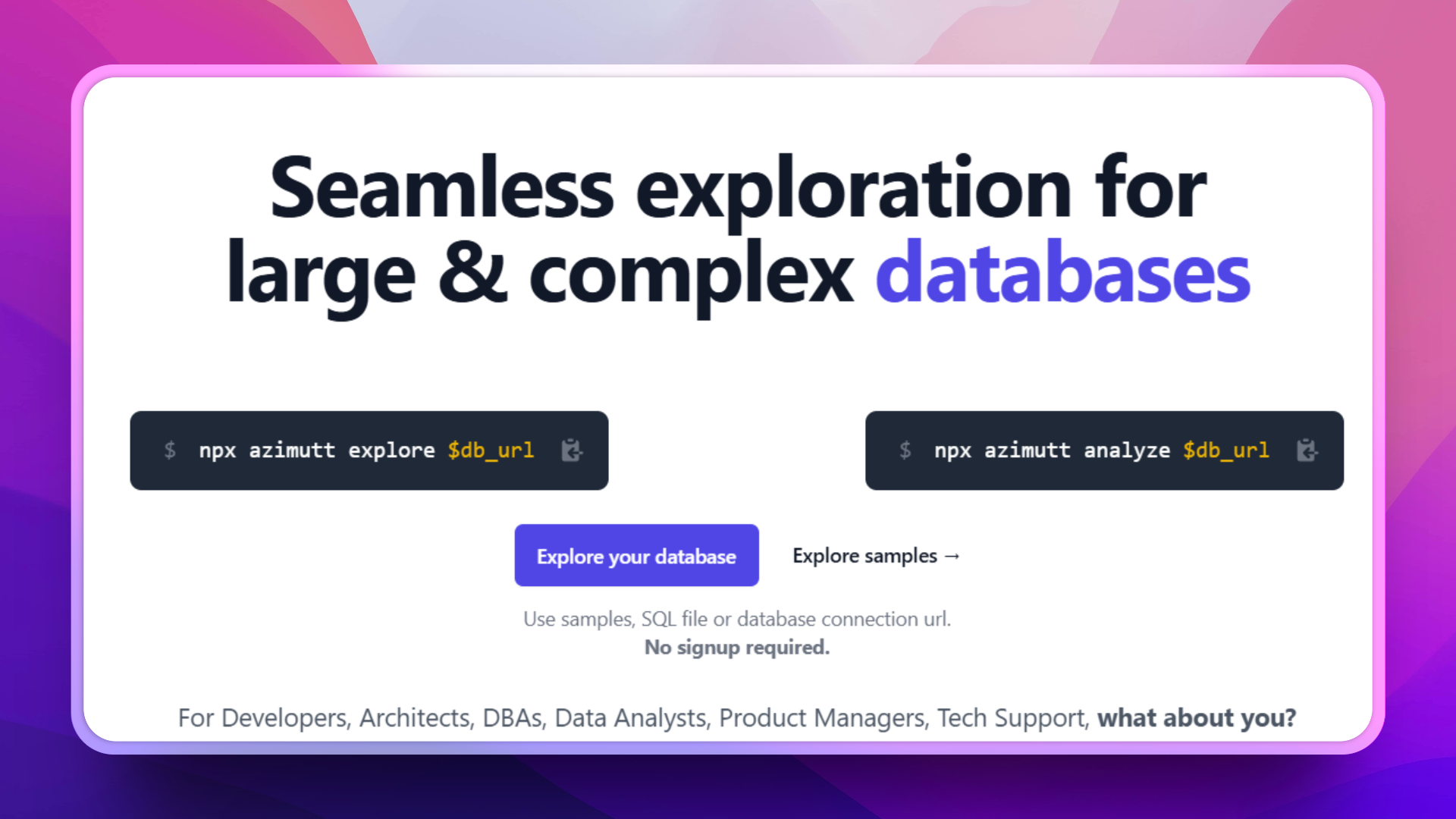
Explore and document complex database schemas visually
Replaces Sqldbm, Redgate Data Modeler
Who it's for
Use Azimutt to map the tables and relationships behind a feature without needing to understand the whole database at once.
Your database has only a few tables and a simple static ERD already answers the question.
Use Azimutt to attach schema notes and explain relationships where engineers regularly need shared context.
Your primary need is operational database administration rather than schema exploration.
The problem
Large production databases are hard to understand through a full-schema diagram. Once a schema has dozens or hundreds of tables, the usual ERD becomes a wall of boxes and lines that hides the relationship a developer actually needs. The pain is worse during onboarding and incident response. Engineers need to answer narrow questions quickly: which tables connect, where a field comes from, and which relationship explains a query or data bug.
How it works
Lets users reveal the part of a schema they need instead of rendering every table at once. This keeps large database maps readable.
Traces how tables connect through foreign keys, helping engineers navigate unfamiliar schemas without manually following every join.
Combines diagrams with schema notes and database analysis so teams can turn investigation work into reusable database knowledge.
Features
- Progressive schema exploration
- Relationship path finding
- Documentation and analysis
Recommended for this setup
Strengths
- Built for existing databases: Azimutt is strongest when the database already exists and the team needs to explore it. That is different from lightweight diagram tools aimed at designing a schema from scratch.
- Works across common database types: The project targets relational and document databases, including PostgreSQL, MySQL, MariaDB, SQL Server, Oracle, MongoDB, and Couchbase topics in its official repository.
Trade-offs
- Not a full database client: Azimutt helps teams explore and document schemas, but it does not replace every query, migration, backup, or administration feature in a database IDE.
Tech stack
FAQ
Azimutt is used to explore, document, and analyze database schemas. It is especially useful for large existing databases where a full ERD is hard to read.
No. Azimutt supports relational database workflows and also lists document database support such as MongoDB and Couchbase in its project metadata.
Azimutt focuses on exploring real databases with progressive reveal, path finding, and schema analysis. Basic diagram tools are often better for small designs created from scratch.