
Ai Goofish Monitor
Automated Xianyu listing monitor with AI analysis and notifications
Replaces —
Who it's for
If you regularly search for a specific product category on Xianyu, this monitor replaces manual search sessions. Configure a task with your keyword set, price ceiling, and an AI prompt describing your quality criteria, then receive alerts only when a matching listing appears.
Skip if your search criteria are simple enough to cover with a single keyword and you check Xianyu infrequently. The setup cost (Docker, API key, account extraction) is not worthwhile for occasional one-off searches.
Multi-task concurrency lets a reseller run separate monitoring tasks for different product types simultaneously. Each task can be assigned its own account and proxy, reducing exposure to marketplace rate limiting across a full set of targets.
Skip if you are sourcing at high volume across dozens of categories. This is a single-server tool with no distributed worker support documented in the README.
The FastAPI backend exposes documented endpoints for task creation, job polling, and authentication. A developer can use the API directly to build custom automation workflows on top of the monitor without touching the web UI.
Skip if you need a stable, versioned API contract. The project is under active development and API shapes may change between releases.
The problem
Tracking second-hand listings on Xianyu by hand is impractical at any real volume. New items appear and disappear within hours, the catalog is large, and searching multiple keyword variations manually while evaluating each listing against your criteria is slow and inconsistent. Missing a good deal because you checked the search an hour too late is a recurring pain for active buyers on the marketplace. The problem compounds when you need to monitor multiple product types simultaneously or filter by region and price range. Manual monitoring forces a choice between checking too often (inefficient) or checking too rarely (missing listings). Xianyu does not provide a built-in alert system that accepts complex criteria and sends notifications only when a listing genuinely matches.
How it works
Each monitoring task runs independently with its own keyword set, price range, region filter (province/city/district), and AI prompt. Tasks can run in real time or on a Cron schedule, and multiple tasks execute simultaneously without blocking each other.
Each new listing passes through a configured OpenAI-compatible model that supports image input. The model receives listing photos and text and applies your criteria to decide whether to send a notification, reducing false positives from keyword-only matching.
Notification channels include ntfy.sh, Telegram, Bark, WeChat Work, Gotify, and custom webhooks. Each is configured through environment variables, and notifications fire only when the AI marks a listing as matching.
Multiple Xianyu accounts can be registered and assigned to individual tasks. A proxy pool with configurable rotation, failure thresholds, and blacklist TTL handles rate limiting and risk control responses from the marketplace.
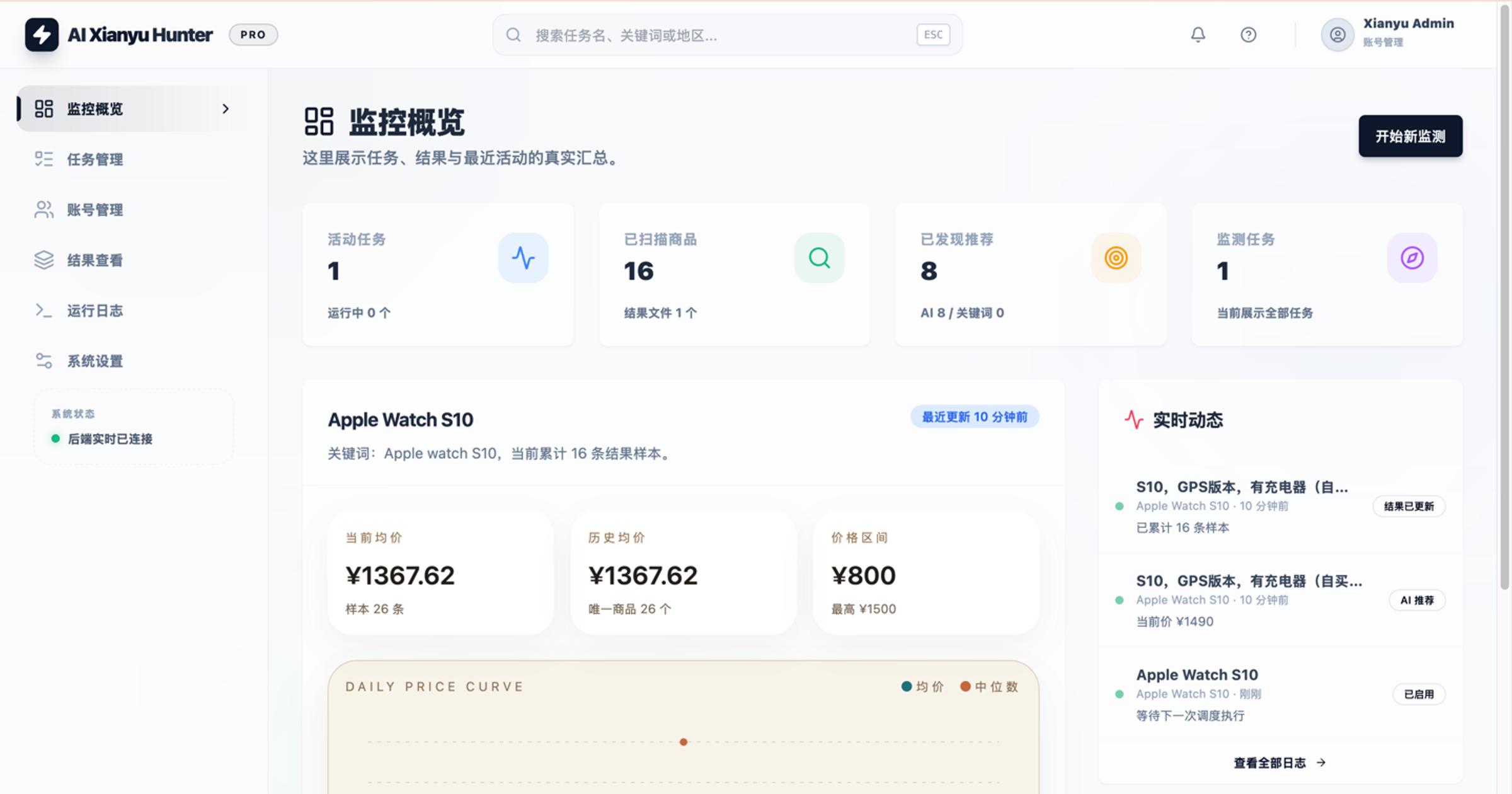
A full web UI at port 8000 covers task creation, account management, AI prompt editing, run logs, and results browsing. Task creation supports both AI-generated criteria (described in natural language) and manual keyword rules.
All task data, results, and price history store in a SQLite database at data/app.sqlite3, mounted as a Docker volume. Login state cookies, prompts, logs, and images each have their own persisted directory, simplifying backup and migration.
Features
- Multi-task concurrent monitoring
- AI-driven listing analysis
- Multi-channel notifications
- Account and proxy rotation
- Web management interface
- SQLite persistence with Docker volumes
How to install
Deploy with Docker using the official container image; configure your AI API key and model in .env before starting.
git clone https://github.com/Usagi-org/ai-goofish-monitor && cd ai-goofish-monitor
cp .env.example .env
docker compose up -d
Recommended for this setup
Strengths
- MIT license with no seat fees: The entire codebase is MIT licensed, so running it on your own server carries no licensing cost. Unlike commercial price-alert SaaS tools with per-user or per-alert pricing, the ongoing cost is only the AI API calls you configure.
- AI analysis works on images, not just text: Second-hand listings on Xianyu include photos that carry condition and authenticity signals a text search cannot capture. The multimodal AI layer evaluates both listing text and photos against your criteria before deciding to notify.
- 16,000+ stars in under 18 months: The repo reached 16,431 stars and 2,846 forks since its July 2025 launch, with active development through October 2026 adding features like SQLite migration and three-tier region filtering after initial release.
- Flexible notification stack: The notification system covers ntfy.sh, Telegram, Bark, WeChat Work, Gotify, and custom webhooks, all configured through environment variables. No integration middleware is needed to route alerts to your preferred channel.
Trade-offs
- Requires Xianyu account with extracted login state: Login state cannot be entered as credentials. You must export a JSON cookie file using the companion Chrome extension and import it through the web UI. This setup step adds friction, and sessions require re-export when Xianyu invalidates the cookie.
- AI API key required for core functionality: The AI analysis layer requires an OpenAI-compatible API key for a vision-capable model. Users without an existing API subscription must provision one before the monitor is functional. API calls add an ongoing cost per listing analyzed.
- Local deployment requires a frontend build step: The Docker image includes the pre-built frontend, but running locally on bare metal requires building the web UI from source using Node.js. The start.sh script handles this automatically, but the initial setup is not a single-command install without Docker.
- 32 open issues as of November 2026: The repo had 32 open issues at the time of writing. As a tool targeting a specific marketplace, edge cases around login state expiry, risk control, and region data staleness appear in the issue tracker.
Tech stack
FAQ
The tool monitors Xianyu (闲鱼), which is Alibaba's China-based second-hand marketplace and is primarily accessible within China. Connecting from outside China typically requires a VPN or proxy configured in the .env file. Proxy rotation support is built in and configurable via environment variables.
Any model accessible through an OpenAI-compatible API endpoint that supports image (vision) input. This includes OpenAI's GPT-4o and locally hosted vision models. The required environment variables are OPENAI_API_KEY, OPENAI_BASE_URL, and OPENAI_MODEL_NAME.
You export your Xianyu login state as a JSON cookie file using the companion Chrome extension, then paste it into the Account Management section of the web UI. The session file saves to the state/ directory. Sessions expire and must be re-exported when Xianyu invalidates the cookie.
The software is MIT licensed and free to self-host. Running costs come from the server hosting Docker and the AI API calls for listing analysis. The AI API cost depends on your model choice and how many listings the monitor evaluates per day.
Yes. The system supports multi-task concurrency, with each task running independently with its own keyword set, price range, region filter, and AI prompt. Tasks can run on a Cron schedule or in real time. Each task can be assigned a specific Xianyu account or left for the system to auto-select.